


Michael Marriott
Studio Visit
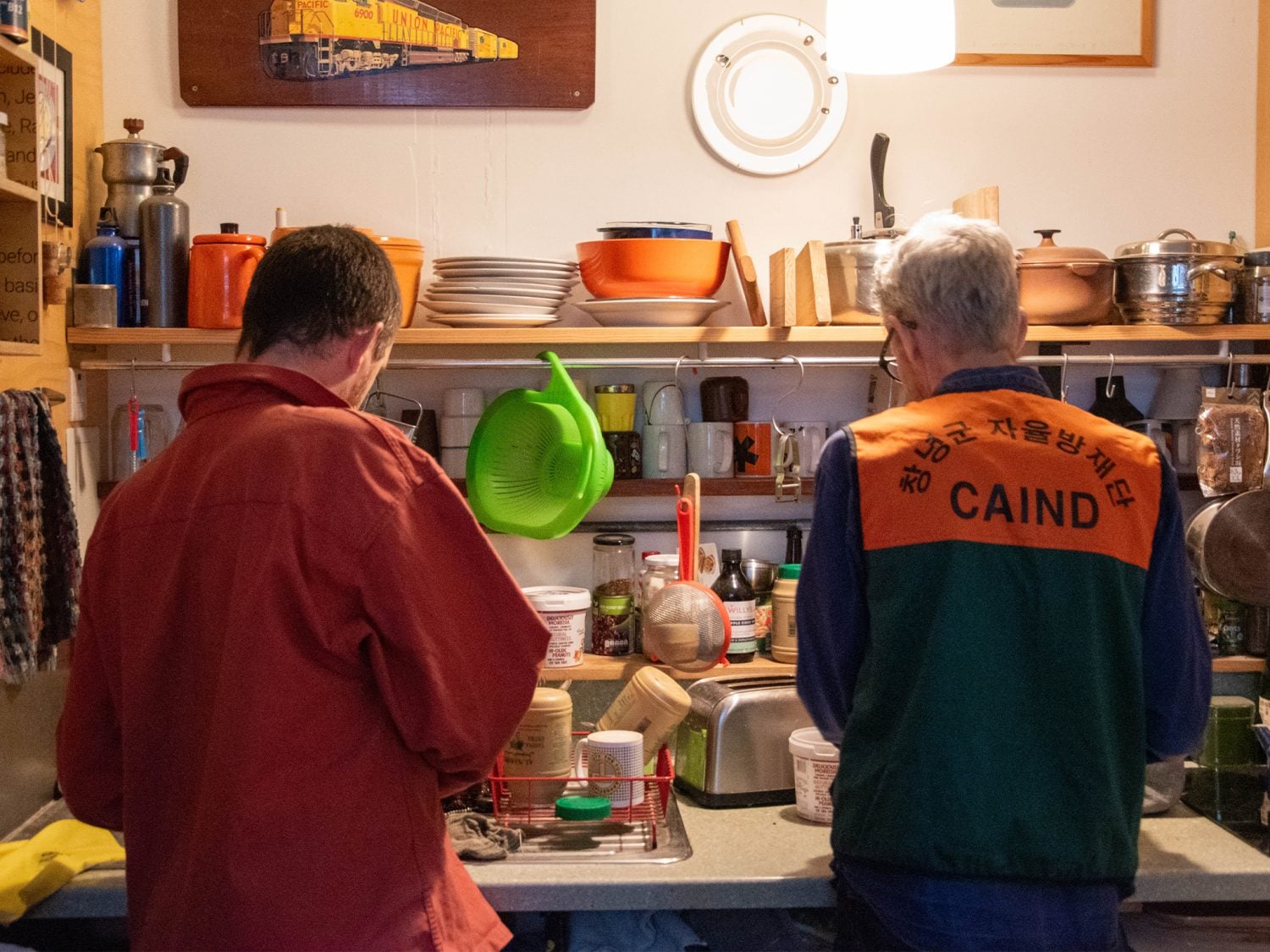
We visited Michael at his Dalston studio last year, to take some photos and to discuss the past, present and future of his working practice.
We visited Michael at his Dalston studio last year, to take some photos and to discuss the past, present and future of his working practice.
Words Duncan Riches, SCP’s Editor.
Studio photography by Sam Grogan.
SCP has worked with Michael Marriot since the mid-1990s, developing products such as 4×4 Table in 1995, Skittle coffee table in 1996, and Hi Honey I’m Home, a coat-stand, in 1997, all of which were recently featured in The Imperfect Archive, SCP’s 40th Anniversary show. Two pieces from 1998 that were not featured are both favourites of mine: Croquet shelving, which is now in production with VG&P, and Missed Daybed, where Michael does an inspired version of Mies van der Rohe. The new Henk side table designed for the 2025 Boxed Collection fits in nicely with all of Marriott’s SCP product output: resolved, spare, with a broad sense of function.
However, to understand Marriott’s influence at SCP, it’s important to look beyond the products, and at his other output: The Arrangement of Furniture, an exhibition and accompanying book, which were created for SCP’s 30th Anniversary in 2015. Or The Bürstenhaus Redecker Müseum, an exhibition and catalogue of German brushes in 2018, which was one of SCP’s most warmly received LDF shows of all time. For LDF 2025, Michael composed Spanish Heavy, a market stall iteration of his WoodMetalPlastic online store, which featured an array of practical objects for design lovers to enjoy.
We visited Michael at his Dalston studio earlier in the year, to take some photos and to discuss the past, present and future of his working practice
“I can quickly do something in the workshop, test it and refine it, with the demands of a real object in real life, in three dimensions. You know, you can feel the weight of it. You can kick it about. You can walk around it, which, for furniture, is really important. For seating, it’s essential that you can sit on the thing.”
Michael Marriott
What does working life in the studio look like at the moment?
Well, right now, it tends to be a mixture of studio and workshop activities, because for the last year or so, I’ve been working alone, which has been a significant change. And I’m really liking that and not wanting to change that. I am still a bit unsure about it, because it’s really handy having an extra pair of hands about. I’ve had ten plus years or more of having people around all the time, or nearly all the time, and it was great. I’ve worked with some really great people, lovely people. It felt like partly an extension of my teaching days, there was a certain amount of tutoring, or mentoring involved. That sort of inevitably happens, because you have to direct people, and sometimes the directing needs some explanation. And also, as you know, as you are chatty by nature, the chat will envelop the greater scenography as well as the item in discussion. Because it contextualises it, so it’s important.
It is.
So the last year or so, it’s been just me, which feels delightful right now. Occasionally I get someone to come in, if it makes sense for something. On the Pasodoble project for example, I needed this complex wire thing drawing in 3d, which I could have done, but I knew it would take me a long time. Instead, I got Frank Winter, another bright young ex-Kingston student to work on it. So I do get little things like that subbed out occasionally, but, ideally, right now, if I had more time, it would be great for me to have to do technical drawings myself, because it forces your brain to have to engage and move.
“I often used to say to students, just do stuff you believe in. Because they would often worry: how do I get paid, and will I get paid enough? And how do I retain copyright or ownership? And I always used to say, just do stuff. If you believe in the thing you're doing enough, do it and get it out there.”
Michael Marriott
Regarding that, when a new project comes in, what does the process look like? Drawings first? Physical prototypes?
Typically doodling and drawing at the beginning, alongside thinking I suppose. Then the next step is normally a computer drawing, normally 2d plans and elevations. I’m a sort of fan of plans and elevations, which suits most of what I do very well. Then I’ll typically go and make a model in the workshop, or in some way. Again, on the Pasodoble project, I had a load of doodles and the beginnings of a drawing, which served to get proportions right. Then quite quickly and crudely, from that, I made a very crude model out of mild steel wire, which is reasonably malleable for what I needed, but difficult to get all the precision that would be required. But I could then test it in real time, as in load test it, check that it was going to do the job and be physically strong enough. Then you’ve got all the information to go back to the computer and refine that drawing so it’s actually useful. Then with that drawing and the prototype I made, Frank could convert that into a technical drawing that could be used to manufacture with.
It’s very back and forth.
Yes. Most of the time, it’s just me, without Frank or someone. But, that’s the kind of a typical way I will work.
I’ve always had you down as someone who likes to test things in the physical space quite quickly.
Definitely, yeah. The workshop is great for that, and integral to the whole process. I can quickly do something in there, test it and refine it, with the demands of a real object in real life, in three dimensions. You know, you can feel the weight of it. You can kick it about. You can walk around it, which, for furniture, is really important. For seating, it’s essential that you can sit on the thing. Then you can adjust the angle or widen the thing, and you do it fast and furious. Then you start designing it. It’s almost like second fit designing, if we use builders terminology. There’s a sort of second fit element where you then go: okay, this is the skeleton of what this thing needs to be. It’s crude in more ways than one, perhaps, but this is the moment where you need to refine it a bit, but without adding anything, other than beauty.
So in terms of a dream working scenario, do you have a picture of the balance of projects you want to work on? Or are you just happy for it to be fairly fluid in terms of the work that comes in?
Fluid suits me. Things just come along. I did this project recently with this little Portuguese architectural publishing house based in Lisbon. They asked me to design a bookmark for them. And at first I thought, well, is this not a job for a graphic designer? We talked about what they were trying to achieve. And I thought, okay, yeah, this feels right. I think they liked what I did and trusted me to bring what was necessary along to the party to make it work. I quite quickly established that a thin brass sheet was the way to go on this, and then it was a question of how we would make it. It’s a good brief, basically: can you design us a bookmark that has a tangible, tactile feel, a certain quality, a presence, the ability to age? One of the things about brass, is it feels sort of valuable, but it also gathers patina very nicely with finger marks and grease.
It’s a very elegant product.
They were delightful people to work with. Another thing that we did was make a slightly bigger production run, and split it half and half. So I can sell half on WoodMetalPlastic, which makes good sense.
Are you invited to take ownership of more different facets of the projects that you work on now?
Perhaps. A lot has happened due to WoodMetalPlastic, but also from people seeing things I do through Instagram and then finding me. That was the case with the bookmark. Similarly, the show I did in Milan at Small Small Space in 2024 was because they had seen my work on Instagram about the show at Leila’s Cafe, they hadn’t visited the show in person. A handful of projects have come about like that. I often used to say to students, just do stuff you believe in. Because they would often worry: how do I get paid, and will I get paid enough? And how do I retain copyright or ownership? And I always used to say, just do stuff. If you believe in the thing you’re doing enough, do it and get it out there. Because if it’s out there and exists with your name on it, and you’re willing to stand by that, that’s what’s important. And even if you don’t earn enough money or earn anything, or even if it costs you money, as long as you believe in it, that’s the crucial thing. Obviously, you’ve got to pay the bills, but that can also be figured out in other ways. Obviously you can’t do that all the time, but I think particularly when you’re starting out, you probably need to do a bit of that. It depends, everyone’s different, but getting your ideas out into the world is critical to development. Now that I have WoodMetalPlastic and with the reach of social media, it provides a kind of window into what I do, and it has brought projects along that I’m so excited by.
The way your practice is set up now, it feels like there’s lots of different ways to potentially work with you. It feels very open-spirited and invitational.
Thinking back a bit, to an earlier stage in my career, when I was teaching at the Royal College in the 1990s. Although the actual teaching only took up 20% of my working week, I found that I was always carrying around my students’ projects in my head. That was one element, and I was quite committed or devoted to teaching during those years. But also I think I definitely had a more narrow view of what I thought I was supposed to be doing then than I do now. As in, I was thinking that I was a furniture designer that also did a bit of exhibition design here and there. I used to think I should be more professional. I should be more like a lot of my peers, like Luke and Tom (founder of design studio Pearson Lloyd) and others, you know, act a bit more professionally, because that’s what the industry model suggests, a certain type of professionalism. Then at some point I realised that what suits me way better is this sort of diverse range of activities. I feel much more comfortable in it, and it’s much more interesting for me. I really enjoy doing exhibition design. You end up working with a curator and a graphic designer, and you have these conversations, to figure out how to frame a group of diverse objects, put them in a space and help with this other team of people, creating the narrative that tells the story that’s required. It’s great to work with new people, having to learn and find out about another world of stuff, like brush making for example, or whatever it is.
How you work now is certainly not a narrow definition of a designer.
Absolutely, and I feel a bit uncomfortable being a designer, and I have a lot of distaste for an awful lot of what the design world produces. The amount of it physically, but also the amount of design that is thrown at each and every object. It feels like, just reduce that 25% and that object might survive. The other thing I realised is that those difficult to define projects that I have worked on, ones that are often required to tell a story, are all design, or are all about design, but depending on where they are situated, they are not always read as that. It’s like there is no accurate category to put them in on my website, but they are projects I feel very at home with and would be scared to lose any aspect of, because I like variety.
The way your practice is set up now, it feels like there’s lots of different ways to potentially work with you. It feels very open-spirited and invitational.
Thinking back a bit, to an earlier stage in my career, when I was teaching at the Royal College in the 1990s. Although the actual teaching only took up 20% of my working week, I found that I was always carrying around my students’ projects in my head. That was one element, and I was quite committed or devoted to teaching during those years. But also I think I definitely had a more narrow view of what I thought I was supposed to be doing then than I do now. As in, I was thinking that I was a furniture designer that also did a bit of exhibition design here and there. I used to think I should be more professional. I should be more like a lot of my peers, like Luke and Tom (founder of design studio Pearson Lloyd) and others, you know, act a bit more professionally, because that’s what the industry model suggests, a certain type of professionalism. Then at some point I realised that what suits me way better is this sort of diverse range of activities. I feel much more comfortable in it, and it’s much more interesting for me. I really enjoy doing exhibition design. You end up working with a curator and a graphic designer, and you have these conversations, to figure out how to frame a group of diverse objects, put them in a space and help with this other team of people, creating the narrative that tells the story that’s required. It’s great to work with new people, having to learn and find out about another world of stuff, like brush making for example, or whatever it is.
How you work now is certainly not a narrow definition of a designer.
Absolutely, and I feel a bit uncomfortable being a designer, and I have a lot of distaste for an awful lot of what the design world produces, The amount of it physically, but also the amount of design that is thrown at each and every object. It feels like, just reduce that 25% and that object might survive. The other thing I realised is that those difficult to define projects that I have worked on, ones that are often required to tell a story, are all design, or are all about design, but depending on where they are situated, they are not always read as that. It’s like there is no accurate category to put them in on my website, but they are projects I feel very at home with and would be scared to lose any aspect of, because I like variety.
“At some point I realised that what suits me way better is this sort of diverse range of activities. I feel much more comfortable in it, and it's much more interesting for me. It’s great to work with new people, having to learn and find out about another world of stuff, like brush making for example, or whatever it is.”
Michael Marriott
What about the future, what’s next?
I am really excited about finding new objects and developing that side of what I do. With WoodMetalPlastic growing and developing, it gives me a sense that I should further expand it, and it’s a lovely project to be working on.
A big thank you to Michael for welcoming us to his studio, for the tea, the conversation, and for his positive and enduring influence on SCP.


